

The day always started with the hearty breakfast buffet provided by the resort where we were vacationing in Singapore.
Mom was laying out the clothes she was planning to wear that day. She was always the first to take a bath and get ready.
Scrolling through his phone gallery, Dad said, “Tanya, I am forwarding to you all these photos that I clicked yesterday.”
“Wait, Dad, let me just see which ones I like. I don’t want to clutter my gallery with multiple copies of the photos.”
“Okay! Here, take my phone and choose the ones you like, and then forward them to yourself.”
Taking the phone from Dad’s hands, I started the struggle of picking between the different versions of the same photos.
Agonizing over minute, virtually indistinguishable differences between photographs, I selected just a few from the dozens we had taken.
As I tapped the share icon, the frequently contacted list appeared automatically.
The topmost name on Dad’s frequent contact list was Dr. Tanya.
Tanya stared at it, confused. The contact was her namesake.
Forwarding the photos to herself, she wondered who Dr. Tanya was. Perhaps a colleague.
But why was this colleague on the list of maximum interaction on her dad’s phone?
Out of curiosity, she clicked on the chat.
Many of the family photographs clicked the previous day were already in Dr. Tanya’s chat.
Tanya scrolled up to read the latest messages.
There was a series of texts:
Hey!!!!
How are you??
Busy, busy??
Nothing dramatic, yet intimate in a way that felt wrong.
With a sinking heart, Tanya read her dad’s reply:
“We are all in the same room, including my daughter.”
Tanya felt something inside her chest tighten—shock, dread, confusion.
Why did her dad need to clarify that all family members were sharing the same room? Did he want to explain why he was not calling her, or worse, imply that there was no intimacy between him and Mom?
Her dad’s voice, indicating his return, made her close the chat and keep the phone aside.
“Tanya, your mom seems to be ready. It’s your turn to take a bath.”
“You go first, Dad. I’ll go later.”
Humming a religious hymn, her father picked up his shaving kit and went into the washroom.
Tanya watched her mom as she chose a corner of the room to sit and chant her prayers.
The vacation in Singapore resulted in Dad getting sick a few days later.
He was supposed to go on an official tour and was irritated that he had fallen ill.
Mom was worried, as his platelet count was very low.
She tried to convince him to postpone his trip, but that irritated him even more.
Finally, he agreed to call the colleague he was supposed to travel with and see if she could handle the important meeting without him.
Passing by his room, I heard him make the call.
“Tanya, I don’t think I will be able to go for this meeting.”
As Mom entered the room with the medicine, Dad said, “Dr. Tanya, do you think you’ll be able to handle it by yourself?”
“Oh, sir, I’m so sorry to hear that you’re not feeling well, but I’m not sure if I will be able to handle it on my own.”
Dad had deliberately added “Dr.” before addressing her in Mom’s presence.
Just a while earlier, he had been informal and was addressing her as Tanya.
Early the next morning, the office staff car brought Dr. Tanya to our house to pick up Dad for the tour.
Dad’s enthusiasm to leave with Dr. Tanya had to be seen to be believed.
Mom, extremely worried, shared her mobile number with Dr. Tanya, requesting her to keep updating her about Dad’s health.
“Don’t worry, ma’am, I’ll keep you updated. He will be okay. He is taking his medicine, and moreover, I won’t let him exert himself.”
That evening, Mom showed me the photographs Dr. Tanya had clicked of Dad drinking coconut water to increase his platelet count.
From no angle did Dad look unwell. He looked happy, drinking the coconut water, seemingly unaware of being photographed.
They returned from the tour after three days.
Tanya observed from her window that Dr. Tanya entered the driveway as if it were her house, with Dad following her, looking exhausted.
All her life, he had made sure he walked at least six feet ahead of her mom, but today, walking six feet behind Dr. Tanya was acceptable to him.
Mom was already waiting outside, her face showing how worried she was.
Dr. Tanya hugged Mom.
“Hello, ma’am. How are you, ma’am? Look, sir is okay now.”
That night, as they had dinner, her father asked about her college exams. Her mother asked about his trip, shared news about the family and neighbors, and served his favorite dishes.
Life continued as before, like nothing had changed.
For most of her childhood, silence was a permanent feature in Tanya’s house. Her father believed he was the only one who was entitled to talk.
Everyone else was boring; only he was interesting enough to be the center of attention.
Undoubtedly, he was very intelligent, learned, and had in-depth knowledge of everything.
During family conference calls, he dominated the entire conversation, and every time Mom tried to add something, he signaled her to stop.
Her father’s voice filled the home environment, and everyone just waited for him to get bored with talking and then leave them alone.
Since childhood, Tanya had seen two versions of her mother: the confident, outgoing, and positive version in Dad’s absence, and the wife who weighed her words before speaking.
Over the next few weeks, Tanya observed her father closely.
He guarded his phone like a prized possession, kept it face down, and pounced on it quickly when it buzzed while they were around.
One night, while Dad went outside to help Mom bring the groceries in, Tanya saw the phone light up with a new notification.
On impulse, she picked up the phone. She knew that the notification center could be accessed even if the phone had a passcode.
As she scrolled, the notifications became visible.
A majority of the messages and missed calls were from Dr. Tanya.
Tanya stared in disbelief and anger. It did not look like a purely professional relationship at all.
She wondered if Mom suspected anything. Had she noticed any changes in Dad? Was she suspicious when he said he needed to buy clothes and wanted her to accompany him to give her opinion?
How did she feel when he finally packed those very clothes to go to conferences with his colleague? Did she wonder why only one colleague accompanied him these days?
Almost every day, Tanya wondered if her mother already knew. Had she chosen to remain silent? Had she decided not to confront her husband to ensure the survival of their family?
Did Mom notice his restlessness while waiting for the official car to take him to the airport? Did she notice how often Dad stayed up late, saying he had calls to make?
After all, there were no photographs, no proof. No one had seen them sitting in a café, leaning toward each other, or walking hand in hand.
He had been very careful to guard his secret life.
He would never acknowledge emotional cheating or admit that hiding texts, deleting chats, or sharing private information with another person was also infidelity.
Being emotionally unavailable to your partner or unfavorably comparing your spouse with someone else is as hurtful as physical cheating.
He would go scot-free, as there was no undeniable evidence.
Tanya knew it would be impossible for her mom to confront her dad due to the lack of proof. He would deny it, say that she always misunderstood him, that she had never been in a professional environment.
Worse still, he would shift the blame onto her mother’s insecurities, her suspicious nature, or her lack of trust in her husband.
He would raise his voice in anger, accuse her of being ungrateful to even suggest such a thing, considering how hard he worked for the welfare of the family.
The silent treatments he had given all her life would seem like a blessing compared to the volcanic eruption of her dramatic dad.
Should she tell her mother? She dreaded the thought. Would her mother finally leave her father?
If she didn’t, how would she live with him after knowing the truth? Would she be able to live with the shame of staying and giving the impression of lacking self-respect?
In the end, nothing would be the same for her mother. Knowing would change everything for her mother, but nothing for her father.
Tanya felt a heaviness in her chest as she realized that she would never be able to make the right decision.
The right decision would mean the end of whatever fragile version of peace existed in her mother’s life.
Tanya decided she would let karma handle it. She chose to remain silent.
Image Courtesy: https://www.canva.com/ai
If you connected with Tanya’s story, share your thoughts and reflections in the comments below.
– Seema Dhameja
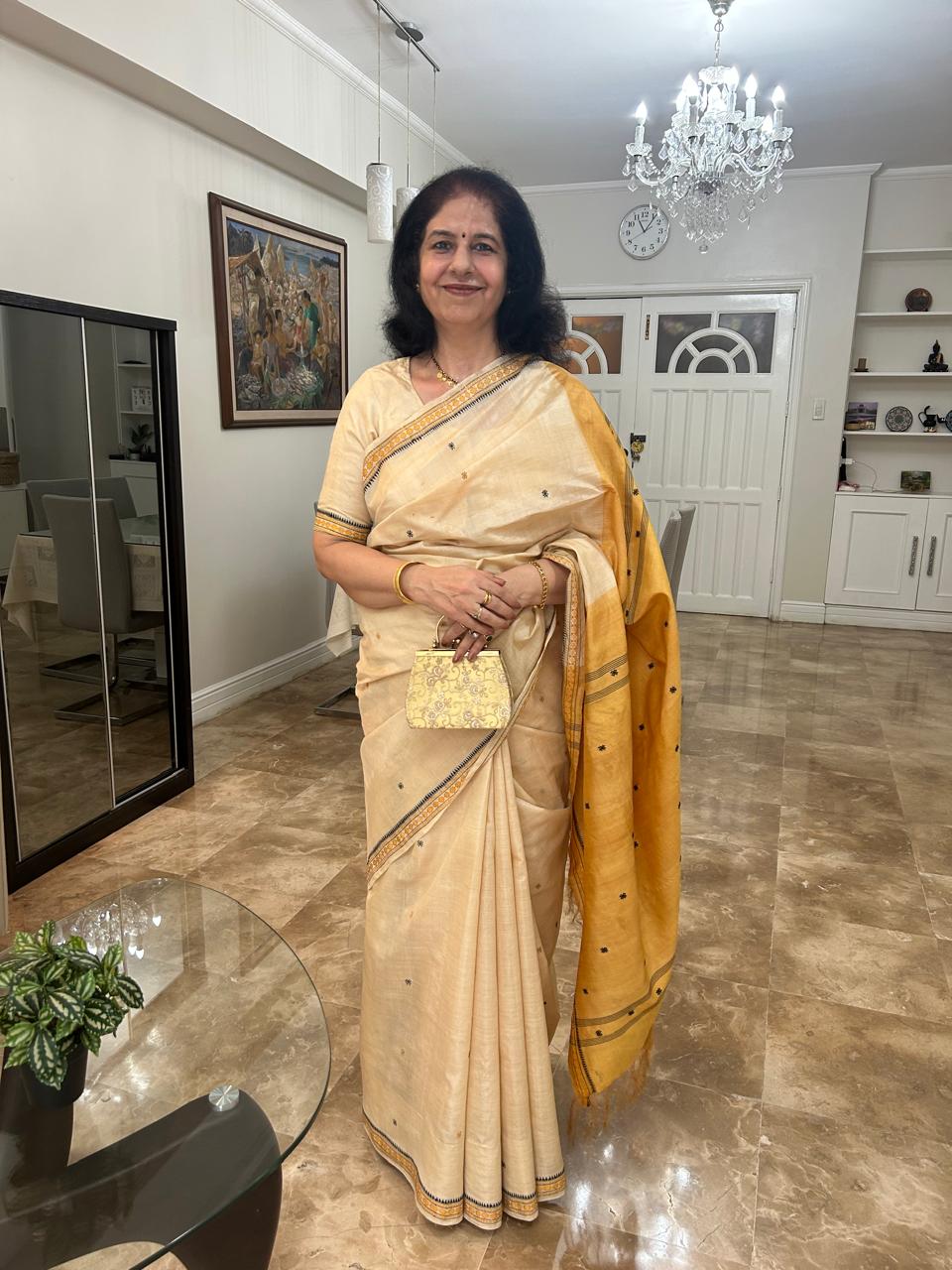
About the Writer
Seema Dhameja holds an M.Phil in Botany and has served as a Lecturer at a Government College in Chandigarh. Her writing journey began with her first published article in the Children’s Column of The Tribune, followed by winning numerous caption contests hosted by the publication.
She has authored and published several articles in The Times of India and Women’s Era. In addition to writing a book on party games, she has co-authored books on environmental studies and industrial psychology.
Seema Dhameja is currently based in Manila, Philippines.


Seema ji, This is a powerful story of tolerance, knowing the things happenning
Why? Is it because the wife is a Homemaker and considered weaker?
A good write-up
It hooked me till the last word
I have seen women suffering silently in my childhood, helplessly