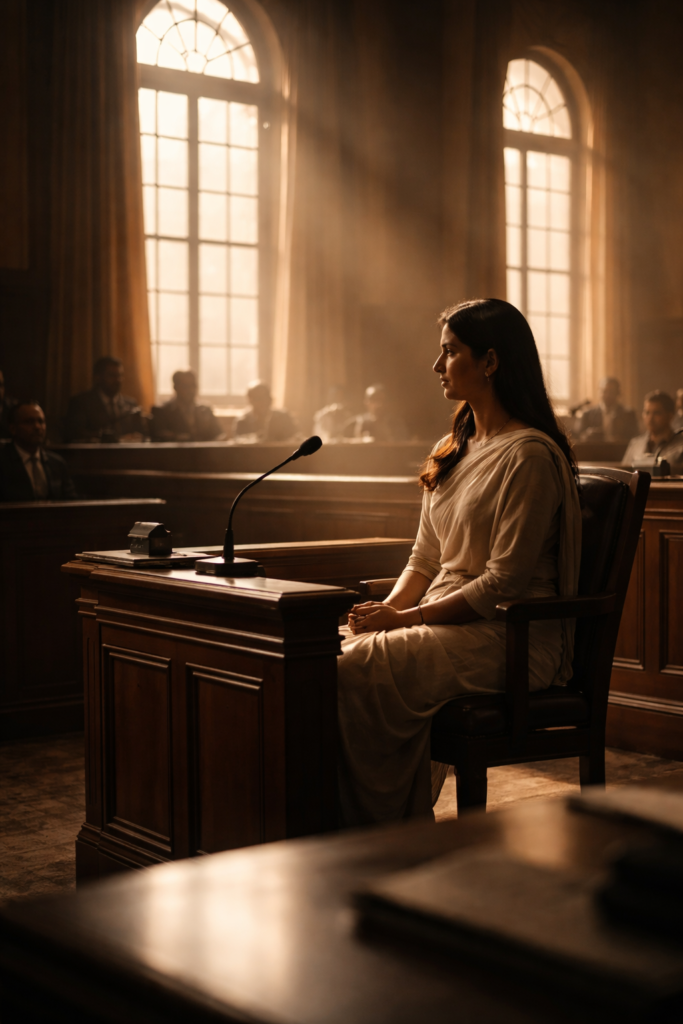
The courtroom smelled faintly of old paper and polished wood. Sunlight slipped through the tall windows and rested quietly on the rows of wooden benches. People whispered in low voices, the soft murmur of curiosity filling the room.
At the centre of it all sat Meera.
She sat very still, her hands folded in her lap, her eyes fixed on the polished floor. The judge’s voice echoed across the room, formal and steady.
“Mrs. Meera Khanna, you have been called as the final witness. Do you wish to make a statement?”
A hundred eyes turned towards her.
Meera did not move.
Only the faint ticking of the clock on the wall could be heard.
Across the room, Rohan stood beside his lawyer. His face looked pale, but he kept glancing at Meera, as if searching for something in her silence.
Three months earlier, everything had been different.
It had been a warm evening when Meera returned home earlier than usual. The house was unusually quiet. As she walked past the study, she heard voices inside.
Rohan’s voice.
And another man’s.
She paused.
The door was slightly open. Inside, Rohan stood near the desk, his voice low but urgent.
“You promised no one would find out,” he said.
The other man, Mr. Sinha, laughed softly. “Relax. It’s just paperwork. The company will never notice.”
Meera did not understand everything that evening. Only fragments reached her ears—numbers, forged signatures, missing funds.
But she understood enough.
Her husband was involved in something illegal.
She had quietly stepped away from the door and returned to the kitchen, her heart beating fast.
That night, Rohan had spoken cheerfully over dinner, asking about her day. Meera watched him carefully, noticing the ease with which he laughed.
He did not know she had heard.
For days, she carried the knowledge like a stone in her chest.
Then the news broke.
The company filed a fraud complaint. An investigation began. Mr. Sinha disappeared. Rohan was arrested.
And Meera was called as a witness.
Now she sat in the courtroom where everything had come together like the final scene of a long play.
The prosecutor cleared his throat.
“Mrs. Khanna,” he said gently, “we have reason to believe you overheard a conversation between the accused and Mr. Sinha regarding the financial documents. Is that correct?”
The courtroom grew quieter.
Meera lifted her eyes for the first time.
She looked at Rohan.
He looked older now, as if the past few weeks had carved lines into his face. His eyes held fear, but also something else—a silent plea.
The judge leaned forward.
“You are under oath, Mrs. Khanna. The court expects the truth.”
Meera knew what the truth was.
She had heard the conversation.
She knew Rohan had been involved.
If she spoke, the case would end quickly. The law would take its course.
Her fingers tightened slightly in her lap.
In that moment, memories rose quietly within her.
Rohan teaching their son Aarav to ride a bicycle.
The two of them laughing over burnt toast on Sunday mornings.
The way he had sat beside her in the hospital years ago, holding her hand when she had been frightened before surgery.
Life was never made of one truth alone.
People were not made of one mistake either.
The prosecutor repeated the question.
“Did you overhear the conversation?”
Meera’s heart beat slowly but firmly.
She knew the law was waiting for her words.
She also knew that her words would close a door forever.
Across the courtroom, Aarav sat beside Meera’s sister. The boy was only ten, his small fingers gripping the edge of the bench. His eyes moved anxiously between his parents.
Meera felt something shift within her.
Justice had many forms.
The law would judge Rohan’s actions through evidence and documents. That would happen with or without her.
But her voice—her voice would decide whether her son lost both his parents in one moment.
The judge spoke again, this time more firmly.
“Mrs. Khanna, please answer the question.”
Meera stood slowly.
Every movement felt heavy, as if the entire room was watching the weight of her decision.
She looked at the judge.
Then she lowered her eyes.
“I… do not remember the conversation clearly,” she said quietly.
The courtroom stirred.
The prosecutor frowned. “You mean to say you heard nothing specific?”
Meera shook her head.
“No, sir.”
It was not entirely a lie.
What she remembered most clearly was not the words, but the moment when her life had quietly changed.
The prosecutor sighed and returned to his seat.
The judge nodded and made a note.
The trial would continue with documents, financial trails, and other testimonies.
Meera stepped down from the witness stand.
As she walked past Rohan, their eyes met for the briefest moment.
He did not smile.
But something in his expression softened—a mixture of relief, guilt, and gratitude that words could never fully carry.
Outside the courthouse, the afternoon sun felt warm against her face.
Aarav ran towards her and held her hand tightly.
“Is everything over, Mama?” he asked.
Meera looked down at him and gently brushed her hair away from his eyes.
“Not yet,” she said softly.
But something had already changed.
For the first time in weeks, the silence inside her felt peaceful.
Sometimes silence was not a weakness.
Sometimes it was simply a choice—a fragile bridge between truth and mercy.
And sometimes, before a person spoke, their silence had already decided the future.
**************
Author’s Note
This story came to me while thinking about the quiet power of silence. In many moments of life, we assume that speaking the truth is the only courageous act. Yet there are times when silence carries its own weight and meaning. I imagined a woman standing at a crossroads where law, family, memory, and compassion collide. The idea of a single moment—a pause before speaking—fascinated me, because within that pause lives a lifetime of choices.
*****************
– Dr. Arwa Saifi

About the Writer
Dr. Arwa Saifi is an acclaimed Career Writer with over 18 years of experience in the literary and education space. Honoured with an Honorary Doctorate in Literature, she is also an Amazon #1 Bestselling Author. Her career includes contributions to Education Times, a supplement of The Times of India, where she brought her expertise to one of the country’s leading newspapers.
Dr. Saifi has served as the editor of several prestigious school and college magazines in Mumbai, shaping young voices and nurturing a culture of expression. She is the author of 10 published books and has collaborated as a co-author in more than 40 anthologies. Her work reflects a deep commitment to storytelling, education, and empowering aspiring writers.